Beyond energy efficiency: New JP e3s publication on energy demand reduction
Share this page
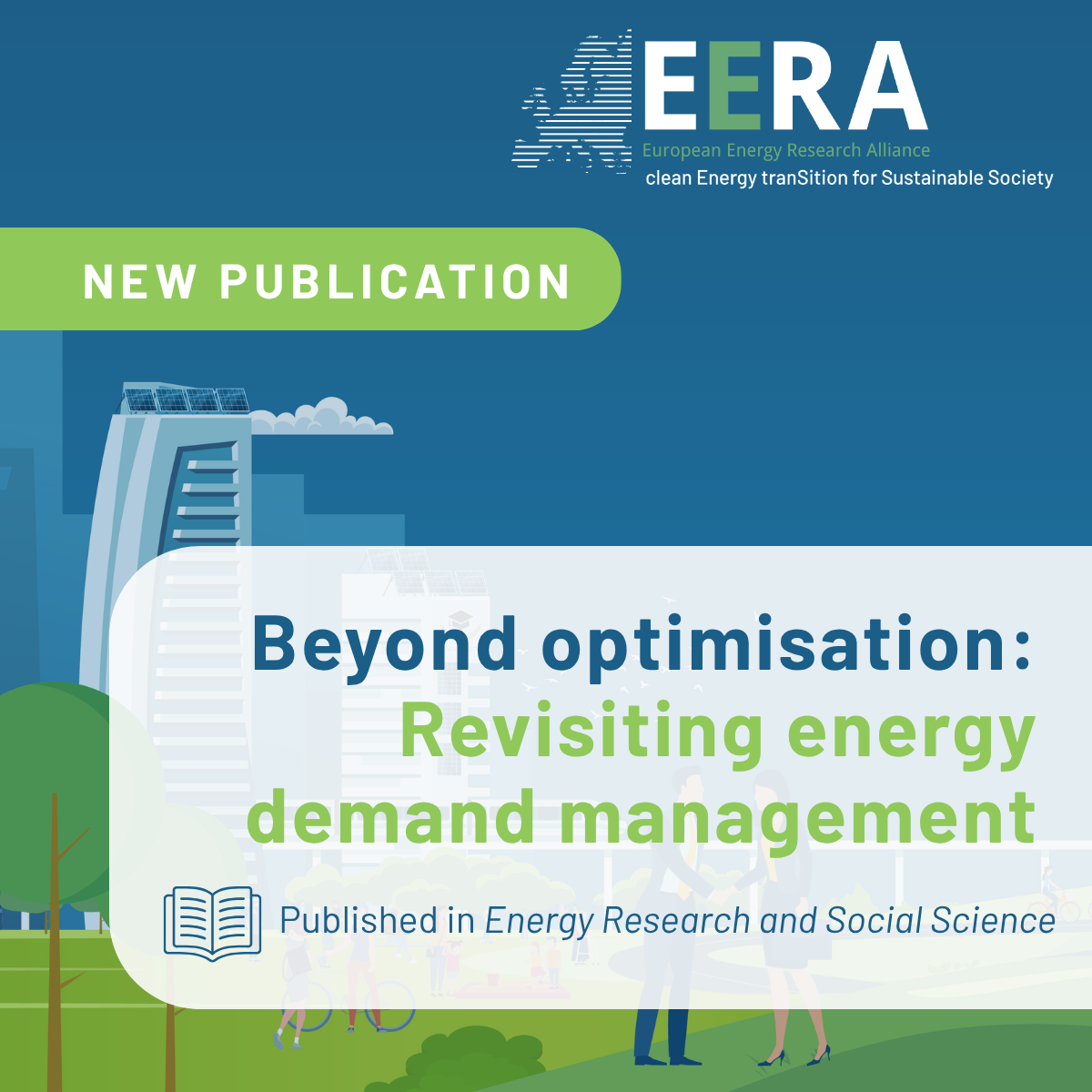
A new article developed in the framework of the EERA Joint Programme JP e3s has been published in Energy Research & Social Science. Entitled “Beyond optimisation: Revisiting energy demand management”, the study examines how energy demand reduction can contribute to Europe’s climate and energy transition, moving beyond a predominantly efficiency-oriented perspective.
The publication stems from activities promoted under JP e3s Sub-Programme 1 “Fostering changes in energy consumption: a pathway to demand reduction”, which brings together expertise from across the JP e3s community to better understand the technological, behavioural and societal dimensions of reducing energy demand.
The article was authored by an international team of JP e3s members, including G. Borragan (VITO and EnergyVille, Belgium), M. Paier (Austrian Institute of Technology, Austria), J. Verheyen (VITO and EnergyVille, Belgium), E. Annunziata (Sant’Anna School of Advanced Studies, Italy), E. Biresselioglu (Izmir University of Economics, Türkiye), G. Calis (Ege University, Türkiye), C. Franceschinis (University of Padova, Italy), T. Koljonen (VTT Technical Research Centre of Finland), P. Pisciella (Norwegian University of Science and Technology), A. Sivrikaya (Hacettepe University, Türkiye), W.R. Poganietz (Karlsruhe Institute of Technology, Germany), M. Thiene (University of Padova, Italy) and A. Sciullo (University of Turin, Italy)
Beyond efficiency: combining technology, behaviour and sufficiency
The study presents a systematic review of 137 scientific studies published between 2004 and 2024, analysing energy demand reduction through three complementary perspectives: energy efficiency, energy sufficiency and behavioural change. The review combines a PRISMA-guided literature selection process with AI-assisted analysis and expert validation.
A central conclusion of the study is that efficiency improvements alone are unlikely to deliver the scale of absolute energy demand reductions required for the energy transition. Instead, lasting reductions depend on integrated strategies combining technological innovation, behavioural adaptation, regulatory and financial instruments, and wider structural changes.
The review also highlights some of the challenges that need to be addressed, including rebound effects, behavioural inertia, fragmented governance and unequal access to energy-efficient solutions. At the same time, reducing energy demand can bring benefits that go well beyond climate mitigation, contributing to energy security, affordability, resilience, public health and social well-being.
Across the scenarios examined in the literature, the authors find that substantial reductions in energy demand are technically and socially possible when technological, behavioural and structural measures are pursued together. The paper therefore calls for energy demand reduction to be treated not simply as an optimisation challenge, but as a broader socio-technical transition requiring coordinated action across policies, infrastructures, institutions and everyday consumption practices.
The publication represents an important outcome of the collaborative work carried out within JP e3s, contributing to a stronger evidence base for understanding how changes in consumption, behaviour and policy can support a more sustainable, resilient and socially inclusive energy transition.