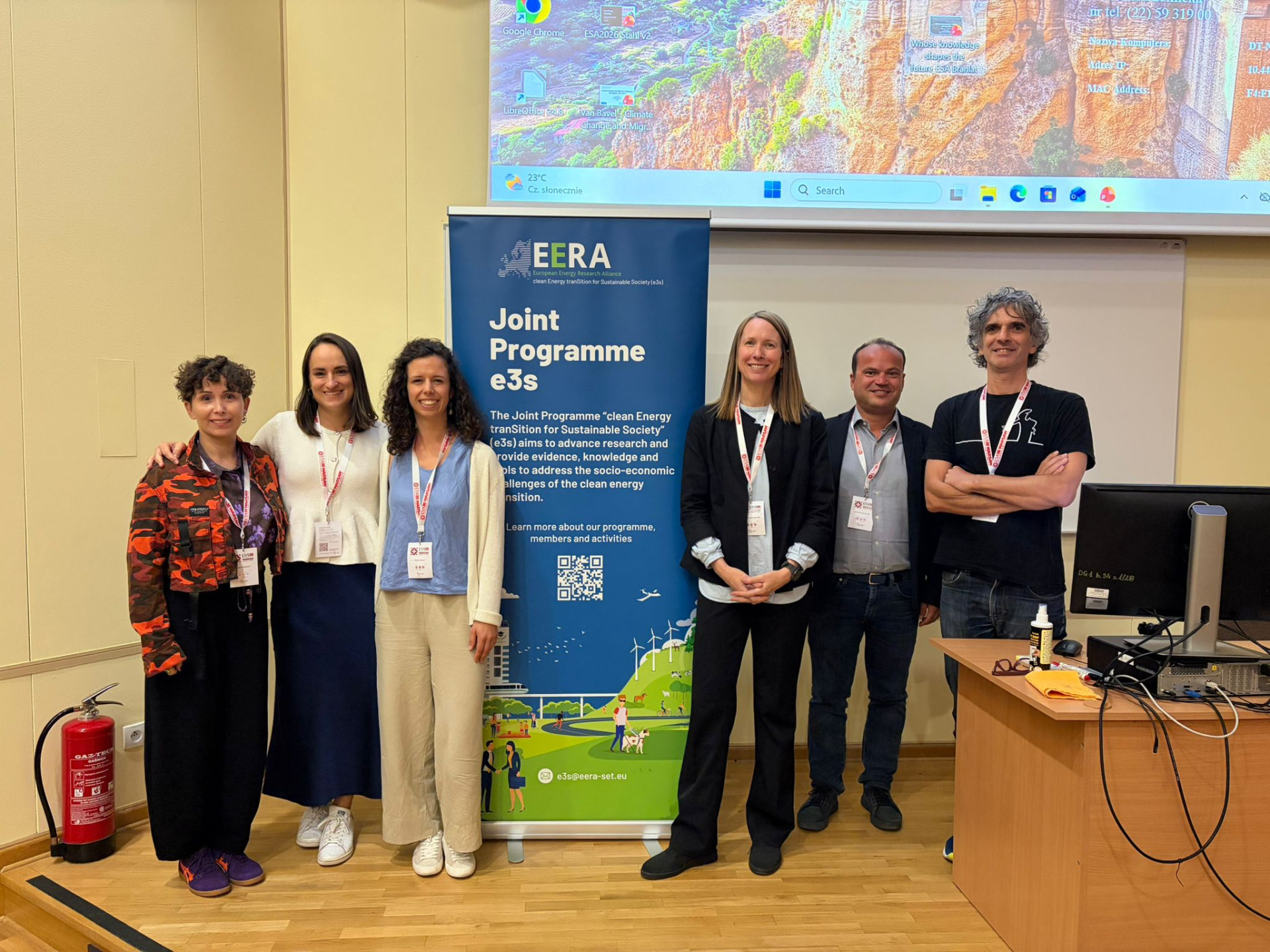
EERA JP e3s brings the gender perspective in energy transitions to ESA 2026
Share this page
On 27 August 2026, the EERA JP e3s participated in the 17th Conference of the European Sociological Association (ESA), held in Warsaw from 25 to 28 August.
JP e3s contributed to the conference with the dedicated session “Bridging the Gender Gap in Energy Research”. The session brought together five research contributions from members of the JP e3s community, highlighting different ways in which gender, intersectionality and inclusion can enrich our understanding of the energy transition.
Ezgi Pehlivanlı (METU) presented research on gender diversity in the European photovoltaic sector, exploring the experiences of underrepresented gender groups and the role of mentoring, organisational practices and support mechanisms in addressing structural inequalities.
Alessandro Sciullo (UNITO) and Margherita Menon (EERA) presented an analysis of the role and representation of women in EU energy policies, examining whether women are recognised as active actors in the energy transition or remain largely marginal within policy narratives and governance frameworks.
Giulia Garzon (EI-JKU) focused on the methodological challenges of integrating gender and intersectionality into quantitative energy research, drawing in particular on evidence from residential electricity consumption and smart-meter data.
Jennifer Elise Branlat (NTNU) presented a work on feminist storytelling as an energy research methodology, showing how alternative forms of knowledge production can help broaden dominant narratives and imaginaries of energy futures.
Finally, Antonio De Nicola (ENEA) presented research on intersecting gender inequalities within the energy transition research community, based on a large-scale analysis of publications, authorship patterns and scientific collaboration networks.
Despite their different disciplinary and methodological approaches, the five contributions converged around a common message: the energy transition is not only a technological and economic transformation, but also a social process shaped by questions of representation, participation, power and inequality.
The participation in ESA 2026 forms part of the activities of the JP e3s Thematic Group “Gender Perspective in Energy Transition”, established in 2025 and coordinated by Jennifer Elise Branlat and Giulia Garzon. The group brings together researchers interested in strengthening the integration of gender perspectives into energy research and in creating opportunities for exchange across disciplines, methodologies and research communities.
The Warsaw session represented an important milestone for the Thematic Group, providing an opportunity to bring its work into dialogue with the wider European sociological community and to connect different strands of research currently being developed within JP e3s.
Through these activities, JP e3s continues to promote a more interdisciplinary and inclusive understanding of energy transitions, ensuring that their social and gender dimensions become an integral part of energy research and debate.
Login as an EERA member
In case you are an EERA member and don’t have login details, please contact a.schneider@eera-set.eu